
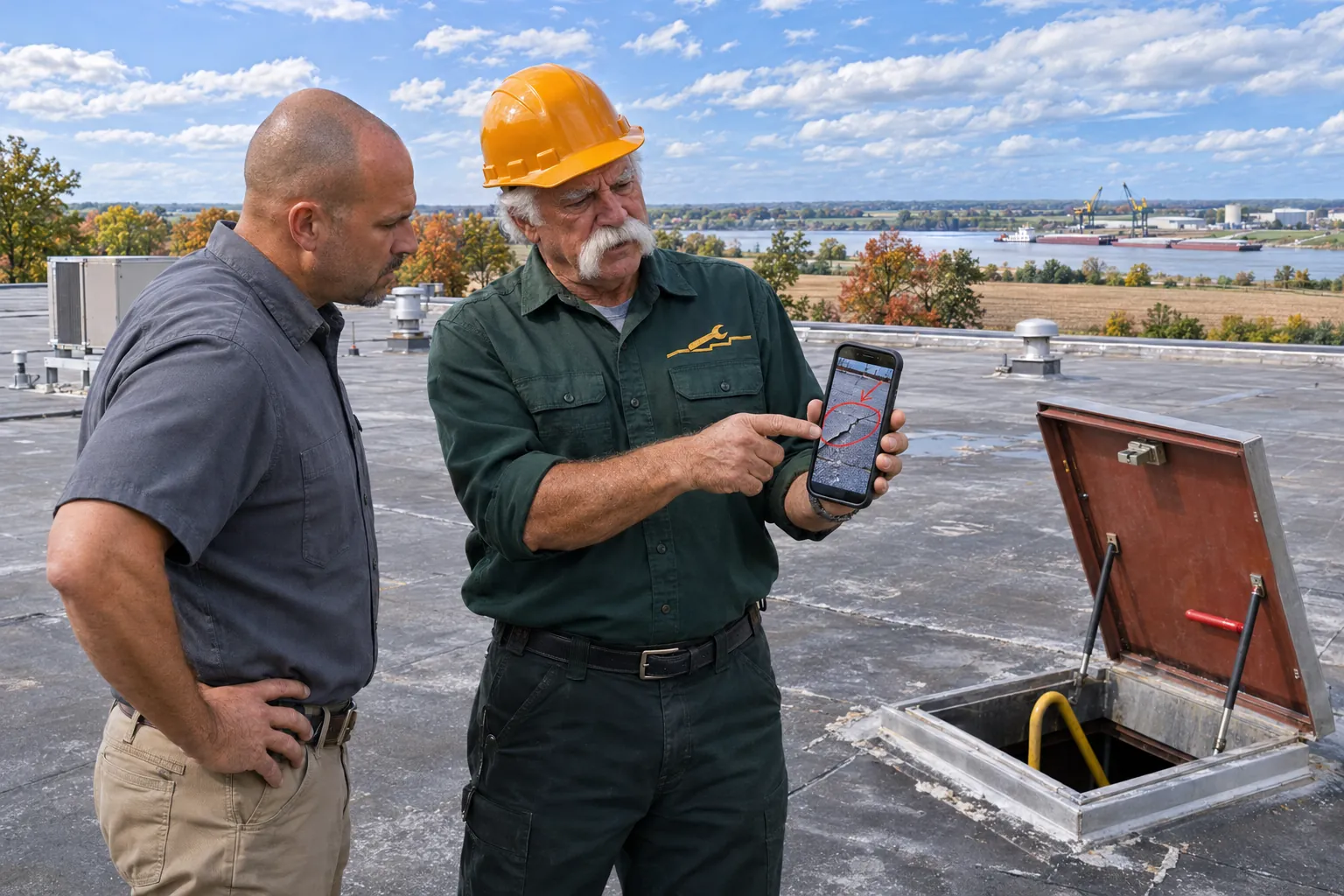
Roofer walking a low-slope commercial roof and checking the membrane
FAQ · Paducah, KY

Commercial Roof Repair Questions in Paducah

Find Out Whether Your Roof Needs a Patch, a Restoration, or More

These commercial roof repair questions in Paducah cover flat and metal roofs, leaks, plants, weather, permits, cost, and the towns we serve.

Commercial Roof Repair Questions in Paducah by Topic

We gathered the commercial roof repair questions in Paducah that owners and facility managers bring up on roof walks, then answered each one by roof detail.

Commercial roof repair is the work of finding and fixing leaks, open seams, damaged flashing and worn metal on commercial, industrial and agricultural roofs. Paducah Commercial Roof Repair fixes flat, metal and industrial roofs across Paducah and McCracken County, Kentucky, plus surrounding towns from Mayfield and Murray to the Kentucky Lake shore.

Roof Repair Basics

What does commercial roof repair cover in Paducah?

Repair work in Paducah covers the parts of a commercial roof that wear out ahead of the rest of the system, such as seams, flashings, drains, fasteners, curbs and damaged patches of membrane or steel.

On flat roofs that means TPO, EPDM, modified bitumen and built-up roofs. On metal buildings it means R-panel and standing seam roofs, along with gutters, ridge caps and trim.

The buildings range from warehouses, plants and shops to churches, schools, offices and farm buildings. Residential roofs are left to other trades.

Should a commercial roof be repaired, restored or replaced?

Spot damage calls for repair, even weathering over dry insulation calls for restoration, and wet insulation or failing details across the roof call for replacement.

OptionRoof conditionWork involved
RepairA few leaks, open seams or loose screwsPatches, reflashing, fastener swaps
RestoreSurface weathered across the roof, insulation dryCleaning, seam and fastener prep, then a fluid-applied coating
ReplaceWet insulation over wide areas or deck damageTear-off or recover with a new system

An infrared or moisture-meter scan draws the line between restore and replace. Patches that keep multiplying are an early sign a roof has moved past simple repair.

What does a permanent roof repair do that a temporary one cannot?

A temporary repair stops water from reaching the interior until conditions allow a proper fix, while a permanent repair rebuilds the failed roof detail with matching materials on a clean, dry surface.

FactorTemporary repairPermanent repair
ConditionsWet or cold roof surfaceDry, clean surface
MaterialsWet-surface mastic, repair tape, weighted tarpsMatching membrane, primer, welded or taped patch, new fasteners
GoalKeep water off stock and ceilingsRestore the seam, flashing or panel
Follow-upRemoved and redoneChecked at the next roof visit

Mastic smeared over an open seam during a storm buys time. Left in place, it traps water and makes the later weld or tape repair harder.

Why should a small commercial roof leak be fixed quickly?

Water entering a low-slope roof spreads through the insulation long before it drips inside, so a small leak at a seam or pipe boot grows into a large area of wet board. Wet polyiso loses much of its insulating value and holds water against the deck.

Over time, steel decks rust along the flutes, wood decks rot, and ceiling tiles and stored goods take damage. Mold can follow inside wall cavities.

Fixing the leak early keeps the repair to a patch and a short section of insulation. Waiting turns the same spot into a cut-out several feet wide.

Paducah Commercial Roof Repair Questions on Flat Roofs

How are open seams on a TPO or EPDM roof repaired?

Open seams on a TPO roof are cleaned and rewelded with hot air, while open seams on an EPDM roof are cleaned, primed and closed with fresh seam tape or a cover strip.

Aged TPO picks up a chalky film that blocks a weld, so the lap gets scrubbed with membrane cleaner first. Sections that still refuse to fuse get a new strip of TPO welded over the old seam.

Older EPDM laps glued with liquid adhesive often let go along long runs. Those laps are peeled back, cleaned to bare rubber, primed and taped, with lap sealant along the edge and at every T-joint.

Should flat roof blisters be opened up, and why do they form?

Blisters form when trapped moisture or air under a membrane or between plies of a built-up or modified bitumen roof expands in the sun. They show up as soft, raised bubbles that grow on hot afternoons.

Small, intact blisters are often left alone and checked on later visits. Large, cracked or growing blisters get cut open, dried out, pressed down and covered with a patch that reaches well past the cut.

A cluster of blisters across one area points to wet insulation underneath. A core cut there shows whether the board needs replacing along with the surface.

Can ponding water on a flat roof be fixed with repairs?

Ponding water on a flat roof can often be fixed with targeted repairs when the cause is a clogged strainer, a drain bowl set too high, or a local low spot. Water still standing a couple of days after rain counts as ponding.

Common repairs follow the cause.

  • Clearing leaves and debris from drains, strainers and scuppers.
  • Resetting a drain bowl to sit flush with the roof surface.
  • Adding tapered crickets under a new membrane patch at low spots.
  • Cutting a new scupper through a parapet where water has nowhere to go.

Sagging decks or ponding across most of the roof point toward structural work or replacement.

How is a puncture in a flat roof membrane patched?

Punctures in a flat roof membrane are patched by cleaning the area, checking the insulation for water, and welding or taping a round-cornered patch of matching membrane that extends several inches past the hole.

Dropped tools, screws left after HVAC service, hail and fallen branches cause most punctures. One puncture usually means others nearby, so the crew searches the whole work zone.

Insulation that feels soft or reads wet under a puncture gets cut out and replaced before patching. Walkway pads added along the service route then keep boots and carts off the bare sheet.

How do I know if a flat roof is too far gone to repair?

A flat roof has moved past repair when wet insulation covers large areas, the membrane has shrunk away from walls and curbs, or the surface is cracking across the field rather than at a few spots.

Watch for these on the roof.

  • Membrane bridging tight across the base of parapet walls.
  • Alligator cracking on a built-up or modified bitumen surface.
  • Patches layered over older patches at the same seams.
  • Spongy areas that spread after each storm.

A moisture scan and two or three core cuts give a clear answer. Dry insulation keeps restoration on the table even when the surface looks rough.

Paducah Commercial Roof Repair Questions on Metal Buildings

How are leaking screws on a metal roof fixed?

Leaking screws on a metal roof are fixed by pulling the backed-out or stripped fastener and driving a slightly larger replacement screw with a new sealing washer, or by reseating intact screws that have loosened. Cracked, dried-out washers are the most common source of drips under exposed-fastener roofs.

Steel panels grow and shrink with each day's heat, and that movement slowly works screws loose and widens their holes.

A screw repair covers the whole affected panel run. Fixing only the screw above a stain leaves its neighbors to leak next season. Overdriven screws that crushed their washers get replaced too.

Can rusted metal roof panels be patched?

Rusted metal roof panels can be patched when the rust is on the surface or limited to small holes, and they need replacement when the steel has thinned or perforated across the panel ends and laps.

Rust conditionRepair approach
Surface rust, steel firmWire brush, rust primer, seal fasteners
Pinholes in a small areaReinforced fabric set in a compatible coating
Holes larger than a coinPatch panel of the same profile, sealed and stitched
Thin steel at eaves or end lapsReplace the affected panel sections

Checking the underside of the panel from inside shows how deep the rust runs, especially along purlin lines.

How do crews repair end laps and side laps that leak on a metal roof?

End laps leak when the butyl tape between overlapping panels dries out or the fasteners through the lap loosen, letting water creep uphill between the sheets. Side laps leak when their stitch screws back out or were spaced too far apart.

Repair options run from light to heavy.

  • Resealing the lap edge and replacing loose stitch screws.
  • Covering the lap with reinforced seam tape pressed into butyl sealant.
  • Opening the lap, cleaning it, and setting new butyl tape before refastening.

Low-pitch metal roofs leak at end laps more than steeper ones, since water moves slowly across the joint.

How do membrane and metal roof repairs differ?

Membrane repairs bond new material to the old sheet with heat, tape or adhesive, while metal repairs rely on fasteners, sealant tape and patch panels that match the rib profile.

ProblemMembrane roof fixMetal roof fix
HoleWelded or taped patchPatch panel or reinforced fabric
Open jointReweld or new seam tapeStitch screws and lap sealant
Leaking penetrationNew boot or refilled pitch panNew boot sealed to the panel flat
Edge damageNew edge metal and strip-inNew trim, closures and fasteners
Drain troubleNew clamping ring and drain flashingGutter reseal and new hangers

Matching materials matters on both. A TPO patch on EPDM, or a steel patch on aluminum panels, fails early.

How are gutters, ridge caps and trim repaired on a metal building?

Gutters on metal buildings are repaired by resealing the seams and end caps, replacing bent or missing hangers, and clearing the downspouts. Water overflowing a clogged gutter runs back under the eave trim and into the wall.

Ridge caps leak when the foam closures underneath crumble or go missing, which lets wind-driven rain and birds into the building. New closures and fresh sealant tape under the cap close that gap.

Rake and eave trim loosened by wind gets refastened with new screws at closer spacing. Torn trim pieces are swapped for matching profiles before the next storm lifts them farther.

Commercial Roof Leak Repair Questions

How is a commercial roof leak traced to its source?

Tracing a commercial roof leak starts at the interior stain and works up to the roof, because water often travels along deck flutes, insulation joints or purlins before it drips. The wet spot on the ceiling and the hole on the roof can sit many feet apart.

The search follows a set routine.

  • Mark the stain and measure its spot from two walls.
  • Find the matching spot on the roof and check every feature upslope.
  • Probe seams, flashings and fasteners in that zone.
  • Water-test small sections with a hose, starting low and moving uphill.

Infrared scans after sunset show wet insulation spreading from the source.

Where do commercial roofs leak most often?

Commercial roofs leak most often where the surface is interrupted, such as seams, flashings, penetrations and edges, and the likely spot changes with the roof type.

Roof typeCommon leak points
TPO or PVCSeam corners, pipe boots, unit curbs
EPDMGlued laps, T-joints, wall flashing pulled taut
Modified bitumen or built-upBlisters, cracked base flashing, pitch pans
Exposed-fastener metalScrews, end laps, ridge caps, skylight panels
Standing seam metalPenetration boots, eave trim, seam ends

Knowing the roof type narrows a leak search to a handful of details before anyone climbs the ladder.

Why does a pitch pan or rooftop curb keep leaking?

Pitch pans keep leaking because the filler inside shrinks and pulls away from the pipe or support, opening a gap that water follows straight down. Pans missing a rain bonnet, or filled with the wrong material, fail again within a few seasons.

Repair means cleaning the pan, adding a pourable sealer to the brim, and shaping a crown that sheds water, or swapping the pan for a pre-formed boot.

Rooftop unit curbs leak at loose counterflashing, base flashing that runs too short, and missing crickets on the uphill side that let water pond against the curb. Unit vibration also loosens screws in the counterflashing.

Can a roof leak be repaired while it is raining?

Rain allows only a temporary repair, such as wet-surface mastic, repair tape or a weighted tarp over the source. The permanent fix waits for a dry roof.

Crews working in rain stay off steep or slick metal panels and away from roof edges. Inside, buckets, tarps and moved inventory protect the building until the weather clears.

Once the roof dries, the temporary material comes off, the damaged seam, flashing or panel is cleaned, and the matching repair goes in. Wet insulation found under the leak gets cut out at that visit.

How are skylight leaks on a commercial roof fixed?

Skylight leaks are fixed at the point that failed, which might be the curb flashing, a cracked dome, a dried gasket, or the laps around translucent panels in a metal roof.

Curb-mounted skylights get new base flashing tied into the membrane and fresh counterflashing at the frame. Cracked domes and worn gaskets are replaced as units.

Translucent panels in metal roofs crack and yellow with age. A new panel of the same rib profile goes in with fresh lap sealant and fasteners at both ends. Safety screens over skylights protect workers who walk the roof during repairs.

Industrial Roof Repair Questions

How is industrial roof repair scheduled around production?

Industrial roof repair is scheduled with plant safety and operations staff, so roof entry permits, hot work rules, air intake shutdowns and equipment lockouts are set before the crew climbs up.

Repairs near process equipment often wait for a planned shutdown. Work elsewhere moves zone by zone, with each patch, reweld or flashing repair finished before the next area opens.

Plant staff can flag stacks and vents that discharge on a cycle. Repair crews time their work near those points around the release schedule and wind direction.

What damage does process exhaust or grease cause to an industrial roof?

Grease and oil exhaust soften EPDM and some other membranes, causing swelling, wrinkling and seam failure in a ring around the fan. Acid or caustic vapors can etch metal panels and corrode fasteners, and heat from stacks cracks nearby flashing.

Repairs remove the damage and change the conditions behind it.

  • Softened membrane is cut out and patched with a grease-resistant material.
  • Grease containment boxes or pads go under kitchen and process fans.
  • Corroded screws give way to fasteners rated for the exposure.

Membrane makers' chemical resistance charts show which repair materials will hold up to a given stream.

What repairs do drains and scuppers need on a big industrial roof?

Roof drains on industrial roofs are repaired by replacing missing clamping ring bolts, broken strainers and torn membrane flashing at the drain bowl. A drain with loose bolts lets water run under the membrane instead of down the pipe.

Scuppers leak where the box meets the parapet wall, through rusted seams in the box itself, or where an overflow opening is blocked.

PartCommon failureRepair
Clamping ringMissing or loose boltsNew bolts, reset ring
StrainerCracked or goneNew strainer
Drain flashingTorn at bowlNew target sheet
Scupper boxRusted seamsNew box and wall flashing

Leaks in drain piping inside the building are a plumbing repair.

How is damage around rooftop equipment repaired on an industrial roof?

Damage around rooftop equipment is repaired by replacing crushed insulation and cover board, patching cuts and punctures, and laying walkway pads where service crews keep walking. Areas around units, fans and roof hatches take the most abuse.

Crushed insulation shows up as a dip that holds water after rain. That section is cut out to the deck, filled with new board, and covered with a membrane patch.

Metal shavings and screws dropped during HVAC work leave rust stains and small holes. A quick sweep after every equipment visit prevents the next round of repairs.

When should a worn industrial roof be restored instead of patched?

A worn industrial roof is ready for restoration when the surface has weathered evenly, the insulation underneath tests dry, and patches are starting to cover more of the roof than the original sheet does.

Restoration cleans the roof, repairs every seam, flashing and fastener, and then applies a fluid-applied coating over the prepared surface. The coating must suit the chemicals that settle on the roof, so plant exhaust data guides the product choice.

Roofs with wet insulation over large areas or a damaged deck skip restoration and move to replacement.

Weather, Permits and Codes in Paducah

What does a storm damage check include after severe weather near Paducah?

Storm damage checks after hail or high wind near Paducah cover the whole roof, looking for lifted edge metal and coping, punctured or bruised membrane, dented panels at the laps, cracked skylights, and torn gutters. Each finding is photographed with the date.

Hail bruises can hide under a membrane that looks intact, so the crew presses suspect spots and checks for crushed insulation.

The National Weather Service office in Paducah keeps records of major regional storms, such as the December 2021 tornado, which help tie roof damage to a dated weather event for an insurance claim.

How do Paducah summers and winters cause commercial roof leaks?

Paducah summers bake dark membranes and expand metal panels every afternoon, while winter freeze-thaw cycles force water in small cracks to swell and widen them. Both seasons attack the same joints from different directions.

SeasonWhat happens on the roofWhere leaks show
SummerMembrane shrinks and pulls at walls, metal expandsBase flashing, fasteners
FallLeaves block drains and guttersDrains, eaves
WinterIce backs up at drains and guttersEnd laps, scuppers
SpringStorms bring wind-driven rain and hailEdge metal, skylights

Seasonal checks in spring and fall catch most of this before it reaches the interior.

Does a commercial roof repair need a permit in Paducah?

Paducah's permit office, the Fire Prevention Division at City Hall, decides when a repair inside city limits needs a permit, working from the city rule that renovations need a construction permit. Small patches and reflashing sit at the light end, while repairs that replace roof sections or change the structure lean toward renovation.

TownOffice for repair questions
PaducahCity Fire Prevention Division
Rest of McCracken CountyCounty Inspection Department
MayfieldCity of Mayfield inspector on the Graves sheet
MurrayCity of Murray contact on the Calloway sheet
Benton and Calvert CityMarshall County Building Office
EddyvilleLyon County inspector

The state's building code, the 2018 Kentucky Building Code, governs any rebuilt roof section.

Can commercial roof repairs be done in cold weather?

Cold-weather roof repairs are possible with the right materials, though primers, adhesives, seam tape and many sealants carry minimum application temperatures that rule them out on the coldest days. Hot-air welding of TPO and PVC seams keeps working in cold air with adjusted settings.

Frost and morning dew on the membrane block adhesion, so winter repairs start late in the morning and finish before evening dew returns.

A leak found in January can get a temporary repair at once and a permanent repair on the first stretch of mild, dry days. Materials stored in a heated space perform better on cold roofs.

Cost, Value and Taxes

What affects the cost of a commercial roof repair?

The cost of a commercial roof repair turns on how many leak sources the roof has, how much wet insulation must come out, and how hard the damaged area is to reach.

Other factors add to it.

  • Roof type and the match of repair materials.
  • Building height, roof access and lift needs.
  • Plant safety rules, permits and escort time.
  • Temporary work done before the permanent repair.
  • Rotten deck or rusted panels found once the roof is opened.

A repair log with dates and locations of past leaks shortens the search and keeps the bill tied to actual work.

When do repeat repairs on a Paducah roof cost more than a bigger fix?

Repeated repairs start costing more than a restoration or replacement when leaks appear in new places every season, new patches overlap old ones, and wet insulation keeps spreading between visits.

A simple record helps owners see the trend. List each leak, its location on a roof sketch, the date, and what was fixed. Clusters along the same seams, laps or flashings show where the system itself is failing.

When most of the record points to one roof area, a section replacement can cost less than repairing that area again. When failures are spread across the roof, restoration or replacement deserves a look.

Are commercial roof repairs deductible, and can they qualify for Section 179?

Routine roof repairs on a business building are usually deducted as ordinary expenses, while larger improvements to the roof of an existing nonresidential building can qualify for Section 179 expensing. A CPA decides which side of that line each invoice falls on.

IRS Publication 946 lists the 2026 Section 179 limit as $2,560,000, phasing out as qualifying property placed in service goes past $4,090,000. Residential rental property is excluded, and Kentucky rules can differ.

Keep repair invoices itemized by task, such as seam welding, flashing replacement or panel swaps, so the classification is clear.

Questions by Town

Which office handles commercial roof repair permits in Paducah?

Inside Paducah city limits, roof repair permit questions go to the Fire Prevention Division at City Hall, which issues the city's building permits, and outside the city they go to the McCracken County Inspection Department. A Paducah mailing address can mislead, since places like Reidland carry that address yet sit outside the city.

The city's permit page says renovations need a permit, while cosmetic finishes are exempt.

A patch over a puncture or a resealed pitch pan sits at the light end. Replacing roof sections, rebuilding a curb for a new rooftop unit, or swapping rusted panels sits closer to renovation.

Why do older brick buildings in downtown Paducah leak at the parapet walls?

Older brick buildings in downtown Paducah leak at the parapet walls because water gets in through the cap and face of the wall as well as through the roof surface. Open joints in the coping cap, cracked mortar and loose counterflashing all let rain into the masonry behind the roof flashing.

Humidity off the Ohio River keeps that masonry damp longer after storms.

Repairs start at the coping. Coping joints get resealed or the cap replaced, counterflashing is reset into cleaned reglets, and rusted through-wall scuppers are swapped out. Leaks that continue after that point to the base flashing where the membrane turns up the wall.

What should Mayfield owners check on a commercial roof after a severe storm?

After a severe storm, Mayfield owners should check their commercial roofs for debris punctures, lifted edge metal, torn gutters and loose rooftop unit panels, and photograph each item before cleanup. The December 2021 tornado, on record with the National Weather Service in Paducah, showed how much damage flying debris does to roofs in Graves County.

Branches and sheet metal from neighboring buildings leave gouges that stay dry until the next rain.

Repairs that replace roof sections inside the city go to the City of Mayfield's building inspector, listed on the state's Graves County contact sheet.

How can Murray owners tell condensation from a roof leak?

Condensation drips across a wide area on cool mornings, even without rain, while a roof leak drips at a specific spot during or after rain. Metal shops and farm buildings around Murray with bare steel over uninsulated interiors show this pattern most.

Telling them apart saves money. Resealing fasteners and end laps stops leaks but leaves condensation untouched, since that water forms on the underside of the panels.

Condensation calls for insulation, a vapor retarder or ventilation. Murray jobs that add insulation or replace panels inside city limits start with the City of Murray building contact listed on the Calloway County sheet.

What roof problems does Kentucky Lake humidity cause for Benton buildings?

Humidity and morning dew from Kentucky Lake keep roofs around Benton damp for longer stretches, which speeds rust on metal panels, gutters and exposed fasteners and feeds mildew on membrane roofs.

The first spots to rust are the panel ends at the eaves, gutter hangers, and screw heads with failed washers. Membrane roofs show mildew near drains and along shaded walls, which holds moisture against seams.

Repair work that goes beyond patching, such as replacing panel runs, goes through the Marshall County Building Office, the countywide permit authority for all construction.

How are roof repairs handled at Calvert City plants?

Roof repairs at Calvert City plants along the Tennessee River in Marshall County start with cleaning, since process residue on the membrane keeps patches, tape and welds from bonding. Seams near stacks and vents fail first where that film builds up.

Crews follow the plant's roof entry permits, fall protection rules and work-zone limits around active exhaust.

Repairs near process equipment wait for planned outages. Every repair material gets checked against the chemicals that settle on that roof, so a patch holds as long as the sheet around it.

What causes clogged drains and gutters on Eddyville commercial roofs?

Trees around Eddyville and Lake Barkley drop leaves, seed pods and twigs onto commercial roofs, and that debris collects in roof drains, scuppers and gutters until water backs up. Backed-up water then finds its way under flashing and through end laps at the eaves.

Fall is the heaviest season for clogs, though spring storms bring down branches too.

Repairs include clearing and resetting strainers, adding gutter guards, and resealing laps that leaked during overflow. Section replacements in Eddyville go to the Lyon County local building inspector named on the Lyon County contact sheet.

Which other towns around Paducah get commercial roof repair?

Repair crews also cover these towns across McCracken, Marshall, Lyon, Livingston, Ballard and Caldwell counties. Nearby water shapes roof wear in several of them, with humidity rusting fasteners and gutters faster.

TownCountyNearby water
GilbertsvilleMarshallKentucky Dam and the Tennessee River
HardinMarshallInland
KuttawaLyonLake Barkley
Grand RiversLivingstonBetween Kentucky Lake and Lake Barkley
SmithlandLivingstonMouth of the Cumberland River
KevilBallardInland
ReidlandMcCrackenInland
La CenterBallardInland
WickliffeBallardOhio and Mississippi rivers
FredoniaCaldwellInland

Getting Started

What happens during a commercial roof leak inspection?

A commercial roof leak inspection pairs an interior look at stains and drips with a roof walk that checks every seam, flashing, drain and fastener above them. The goal is to find each source and decide between repair, restoration or replacement.

Inspectors record photos and notes on these items.

  • Interior stains, with their position measured from walls.
  • Damaged seams, laps and flashings found upslope.
  • Wet insulation found by probing or scanning.
  • Drains, gutters and scuppers that hold water.

Paducah Commercial Roof Repair finishes each inspection with a list of repairs ranked by how fast water is getting in.

What should building owners do while waiting for a roof repair?

While waiting for a roof repair, building owners should protect the interior, record what the leak does, and keep people off a wet or damaged roof. Buckets, tarps over stock, and moved equipment limit the damage inside.

A short log speeds the repair.

  • Times drips start and stop compared with rainfall.
  • Photos of ceiling stains and the roof above them.
  • Changes after wind, as opposed to steady rain.

From the ground, check whether gutters overflow or downspouts run dry during a storm. Those clues point to clogged drains and scuppers before anyone goes up.

Sources

Have a Leak That Needs an Answer Today?

Call and describe the stain, the roof type, and when the drip started. We will tell you what can be done now and book the roof walk.

Still Have Commercial Roof Repair Questions in Paducah?

Ask about your own roof on the phone, or request an estimate and we will answer it on the roof walk.

Call Us (270) 260-2463